
Choosing Transformer Cores for Medical X-Ray and Special Power Supply Applications
Choosing Transformer Cores for Medical X-Ray and Special Power Supply Applications
In medical X-ray generators and special power supplies, the transformer core decides whether output stays stable through a cold start, a fast pulse train, and hours of continuous thermal load. For these duties the practical answer is usually a thin strip core - block core, toroidal core, or pulse transformer core - wound from silicon steel or permalloy, with low-loss performance of ≤1.0 W/kg at 1.5 T and 50 Hz and an operating temperature range of -40 °C to 120 °C. Where the design needs precision current sensing or very high permeability, permalloy grades 1J85, 1J79, and 1J50, together with custom toroidal wound non-standard iron cores, become the deciding options.
This guide is written for the engineer or procurement engineer who must make that specification once and live with the consequences for the life of the product. It explains where conventional cores break down in X-ray and special power supply designs, how thin strip cores and permalloy grades are matched to specific duties, and what should be verified before a design is frozen.
Wuxi Yado Electromechanical Co., Ltd., which sells under the brand YadooTEK from Jiangyin City in Wuxi, China, manufactures and exports wound and laminated transformer cores - toroidal cores, C cores, electrically wound iron cores, special-shaped iron cores, stepped laminated cores, lap-joint and right-angle laminations, EI/ED/SD/CD cores, and thin strip cores - as well as customized transformer cores built to customer drawings. The company was established in 2022 and exports approximately 85% of its output to markets in North America, Europe, Latin America, the Middle East, and Asia-Pacific.
The article follows a decision path: the problem, the industry context, the solution set, a specification sequence, real use cases, a comparison table, and the questions buyers ask before ordering.
The Problem: Why a Standard Core Is the Wrong Starting Point
A core that performs adequately in a general-purpose transformer can fail three ways inside an X-ray generator or a special power supply: it can lose inductance under pulse or DC bias, it can heat the assembly through core loss, and it can drift as the temperature moves. The failure modes documented for transformer cores in these conditions are excessive core temperature rise, magnetic saturation, excessive core loss, insulation failure, and dimensional deviation.
Magnetic saturation under short, high-current duty
An X-ray generator is not a steady-state load. The high-voltage tank converts a fast switching waveform into a high potential for a short exposure, and the filament circuit adds a second, separate current path. When the core reaches saturation, inductance collapses, current rises faster than the control loop expects, and the visible symptom is unstable kV or unstable emission rather than an obvious component failure.
Core loss becomes heat inside a closed enclosure
Every watt of core loss turns into heat. In an oil-filled tank or a potted power supply, that heat has few places to go, and loss that increases with temperature creates a feedback loop. This is why low-loss material behaviour is specified in watts per kilogram at a defined flux density and frequency - a number that can be tested - rather than described in general terms.
Insulation failure in high-voltage assemblies
Inside an X-ray tank the core is part of the insulation system, not just a magnetic component. Burrs on strip edges, inconsistent inter-lamination insulation, and poor layer alignment concentrate electric field and reduce withstand margin. Insulation failure is a safety event, so it is treated as a design constraint rather than a quality statistic.
Dimensional deviation changes the electrical result
Window dimensions, stack height, and layer alignment determine winding fit, leakage, and repeatability. A core outside tolerance changes the electrical result from one unit to the next, which is especially costly in a product that carries a calibration routine. The precision baseline referenced throughout this article is lamination precision of ±0.02 mm, the tolerance achieved by the high-precision wound cores described below.
Sensing accuracy is a material question
Precision current sensing in a power supply depends on high magnetic permeability, low coercivity, and low remanence, and those are material properties, not winding techniques. Instrument-grade permalloy grades exist precisely because a silicon steel core cannot deliver that behaviour at low signal levels.

Industry Background: A Core Market Being Re-Examined
The global transformer core market was valued at USD 9.66 billion in 2024 and is projected to reach USD 15 billion by 2034, according to Zion Market Research. Estimates differ slightly between research houses because the scope differs - power, distribution, and instrument transformer cores are counted differently - with IMARC Group publishing USD 9.6 billion and Strategic Market Research publishing USD 11.2 billion for the same 2024 period.
Grain-oriented laminated steel (CRGO) remains the volume material of the category: it held a dominant 79.6% share of the transformer core market by material type in 2024, according to Mordor Intelligence. That share is important context for a medical or instrumentation buyer, because it means the thin strip, permalloy, and non-standard geometries discussed in this article come from a specialist corner of a market that is otherwise dominated by mainstream power lamination supply.
On the supply side, China's exports of electrical transformer parts, including cores, reached approximately USD 4.8 billion in 2024 and led global exports, according to UN Comtrade / WITS data. For international buyers engineering a medical device or a special power supply, this is the sourcing reality: a large part of the world's core capacity - including the wound and laminated formats used in instrument-grade applications - is located in the Chinese supply chain and shipped globally.
Standards set the verification floor. Power transformers and reactors are governed by the IEC 60076 series, which specifies general requirements and testing for cores, published by the International Electrotechnical Commission. A core datasheet alone does not demonstrate compliance; the test method and the certificate behind it do.
Material alternatives also shape the decision. Amorphous alloy cores reduce no-load losses by 70% to 80% compared with traditional silicon steel (CRGO) cores, according to Electrical Trader. That figure addresses no-load loss specifically, which is one criterion among several that an X-ray or pulse design must weigh - saturation behaviour, pulse fidelity, mechanical handling, and cost of ownership all enter the decision.
The companies named most frequently in transformer core market reporting are ABB, Siemens Energy, Hitachi Energy, and GE Vernova, according to Stellar Market Research. These names are associated mainly with complete transformer and grid equipment portfolios; the small, high-permeability, non-standard cores used inside X-ray and instrumentation power supplies are typically sourced from specialist core manufacturers rather than from grid-scale suppliers.
The Solution Set: Thin Strip Cores, Permalloy Grades, and Custom Geometries
The core options that answer the problems above fall into three groups: thin strip cores in block, toroidal, and pulse transformer formats; high-permeability permalloy grades 1J85, 1J79, and 1J50; and custom toroidal wound non-standard iron cores produced to drawing.
Thin strip cores: block, toroidal, and pulse transformer formats
A thin strip core is wound or stacked from thin-gauge electrical steel or permalloy strip rather than assembled from thick laminations. The thin gauge reduces eddy-current loss, the wound construction keeps the magnetic path continuous, and the result is a core that can be specified with low-loss performance of ≤1.0 W/kg at 1.5 T and 50 Hz across an operating temperature range of -40 °C to 120 °C.
Within the thin strip family, three formats cover most X-ray and special power supply duties:
- Block core. A wound block format used for the main transformer in a high-voltage generator tank, where low loss and stable behaviour at a defined flux density matter more than the lowest possible material cost.
- Toroidal core. A closed-path ring that keeps leakage low and external field small - the usual choice for filament isolation transformers, gate drive transformers, and sensing transformers inside the same enclosure.
- Pulse transformer core. A thin strip core selected for fast rise time and minimal pulse distortion in capacitor-discharge and pulse X-ray stages, where high dV/dt makes thin gauge essential.
The material decision inside the thin strip family is straightforward. Silicon steel strip gives high flux density and cost efficiency for the main power path. Permalloy strip gives high permeability and low coercivity, and it is used where the signal is small or the accuracy requirement is tight.
Permalloy grades 1J85, 1J79, and 1J50 for precision current sensing
Permalloy grades 1J85, 1J79, and 1J50 are nickel-iron alloys used for high-permeability duties, including precision current sensing in power supply control loops and instrument transformers. Because they share a family name but not a property profile, the practical selection logic is to identify the limiting condition first.
- 1J85 is selected when the highest permeability is the priority - low-level signal sensing and high-accuracy current transformers where sensitivity at small currents determines the design margin.
- 1J79 is selected as the balanced option, where high permeability is needed alongside practical processing and consistent manufacture of wound toroids.
- 1J50 is selected where the flux swing is larger, or where a DC component is present and flux headroom matters more than the last increment of permeability.
In a medical X-ray context this choice rarely stands alone. The same system may need a 1J85 toroid for a low-level sensing function and a silicon steel thin strip core for the main power conversion stage, which is why a supplier that manufactures both material families is easier to qualify than two separate vendors working to two separate tolerance systems.
Custom toroidal wound non-standard iron cores
The reason a medical or instrumentation design usually ends up needing a custom core is mechanical, not magnetic: the available window height, the mounting pattern, the lead exit, or the space beside a cooling channel rarely matches a catalogue size. Non-standard iron cores wound to drawing allow the electrical design to stay fixed while the core is fitted to the enclosure instead of the enclosure being redesigned around a standard core.
What YadooTEK supplies for these applications
The YadooTEK product matrix covers both sides of the decision. Wound cores include toroidal cores, C cores, electrically wound iron cores, and special-shaped iron cores. Laminated cores include stepped laminated cores, lap-joint and right-angle laminations, EI/ED/SD/CD cores, and stepped cores, alongside thin strip cores. Customized transformer cores are produced to customer specification.
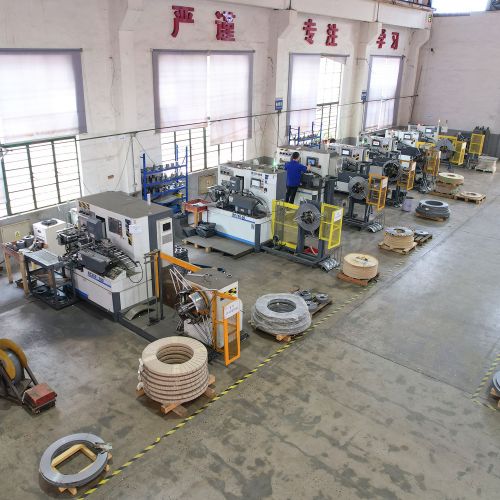
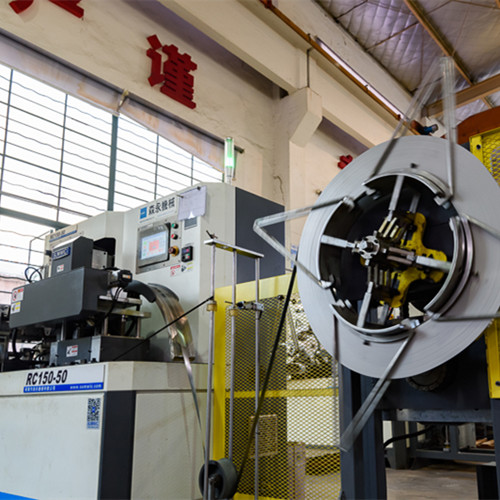
The manufacturing base behind that matrix is a 1,000 m2 facility with 80 employees, an annual output of 250,000 units, and a 25-engineer R&D team. Testing uses core magnetic testing instruments and transformer capacity and loss testing instruments. Quality control covers incoming material inspection, 100% core loss testing, third-party authoritative certification, full life cycle quality traceability, and 24-hour technical support.
The measurable position against the conventional baseline is stated in the product comparison: compared to conventional ordinary silicon steel cores, this transformer core product has distinct advantages - core loss reduced by over 30%, magnetic permeability increased by 2 times, and lamination precision of ±0.02 mm, with total life cycle cost reduced by 15% and long-term operation and maintenance cost saved by 20%.
Comparison Table: Matching Core Options to Real Duties
The table below compares core options against the criteria that matter in X-ray and special power supply design. It compares design suitability, not brand superiority; where a figure comes from a named third party, the source is stated.
| Core option | Typical duty in X-ray / special power supply | Verified performance or cost point | Source |
|---|---|---|---|
| Conventional ordinary silicon steel core (baseline) | General-purpose lamination in low-demand supplies | Baseline for comparison: lower permeability and higher core loss than the high-permeability wound alternatives described here | YadooTEK product comparison (CORPUS) |
| Thin strip / wound high-permeability core in silicon steel or permalloy (block, toroidal, pulse) | HV generator transformer blocks, pulse stages, filament isolation, sensing | Core loss reduced by over 30%, permeability increased by 2x, lamination precision ±0.02 mm; total life cycle cost -15%, operation and maintenance cost -20%; low loss ≤1.0 W/kg at 1.5 T and 50 Hz; operating range -40 °C to 120 °C | YadooTEK product comparison (CORPUS) |
| Permalloy toroidal core, grades 1J85 / 1J79 / 1J50 | Precision current sensing, low-level signal and instrument transformers | Selected for high permeability and stable low-level signal behaviour; grade chosen by whether sensitivity, balanced processing, or flux headroom is the limiting condition | YadooTEK permalloy offer (CORPUS) |
| Amorphous alloy core | Low no-load-loss duty | No-load losses reduced by 70%-80% versus traditional silicon steel (CRGO) cores | Electrical Trader, 2024 |
| CRGO grain-oriented laminated core | Mainstream power and distribution lamination | Held a dominant 79.6% share of the transformer core market by material type in 2024 | Mordor Intelligence, 2024 |
Reading note: the amorphous figure refers to no-load loss only, and the CRGO figure describes market share rather than suitability for instrument duty. Neither should be read as a ranking of core quality - each option answers a different requirement.
Step-by-Step: Specifying a Core Without Rework
- Write the electrical duty down. Frequency, flux density, pulse width and rise time, any DC bias, and the required sensing accuracy. A core cannot be selected from a description of the application alone.
- Choose the material class. Silicon steel where flux density and cost efficiency dominate; permalloy 1J85, 1J79, or 1J50 where permeability and low-level accuracy dominate; consider amorphous only if no-load loss is the overriding criterion.
- Choose the geometry. Block core for the main high-voltage transformer, toroidal for isolation and sensing, pulse transformer core for fast pulse duty, and CD cut, EI, or stepped laminated formats where the winding and assembly method requires them.
- Design to the thermal window. Specify against an operating range of -40 °C to 120 °C, and verify with a temperature rise simulation test rather than assuming the enclosure will absorb the difference. Precise material selection and an optimized magnetic circuit are the two levers that keep temperature rise under control.
- Lock dimensional and loss control. Treat lamination precision (±0.02 mm in the high-precision wound cores described here) and 100% core loss testing as acceptance criteria in the purchase specification, not as promises.
- Validate, then lock the supply chain. Confirm behaviour on samples, then secure full life cycle quality traceability, third-party certification, and a technical support channel - YadooTEK provides 24-hour technical support for this stage.
Use Cases: Where These Cores Are Specified
1. High-voltage generator tanks
The main transformer inside an X-ray generator tank is the classic block core application: stable behaviour at a defined flux density, low loss inside an oil-filled enclosure, and repeatable dimensions so that every unit calibrates the same way.
2. Filament and rotor drive transformers
Filament heating and rotor drive circuits use toroidal cores, where the closed path keeps leakage and external field low - an advantage when several magnetic components share a confined, high-voltage enclosure.
3. Precision current sensing and feedback loops
Current transformers and sensing toroids wound from permalloy 1J85, 1J79, or 1J50 support the accuracy that X-ray dose control and power supply feedback loops require. Grade choice follows the limiting condition: sensitivity, balanced processing, or flux headroom.
4. Pulse stages and capacitor discharge
Pulse transformer cores built from thin strip material handle fast dV/dt with limited distortion, which is why thin gauge rather than thick lamination is specified for these stages.
5. Special power supplies
Beyond X-ray, the same low-loss, high-permeability logic applies to high-efficiency power transformers, precision instrument transformers, new energy inverters, EV charging stations, high-frequency inductors, and low-loss reactor systems - the application set these cores are built for.
FAQ: Choosing X-Ray and Special Power Supply Cores
Which standards and certifications apply to a core used in X-ray or special power supply equipment?
Power transformers and reactors are governed by the IEC 60076 series, which specifies general requirements and testing for cores. At the core level, buyers normally verify incoming material inspection, 100% core loss testing, and third-party authoritative certification. YadooTEK applies all three and adds full life cycle quality traceability, so a delivered batch can be traced back to its material lot.
Can you supply permalloy 1J85, 1J79, and 1J50 cores, and custom toroidal wound non-standard iron cores?
Yes. YadooTEK manufactures and exports wound cores (toroidal cores, C cores, electrically wound iron cores, special-shaped iron cores), laminated cores (stepped laminated cores, lap-joint and right-angle laminations, EI/ED/SD/CD cores, stepped cores, thin strip cores), and customized transformer cores built to drawing. A 25-engineer R&D team supports grade selection and non-standard geometry, which is usually needed when the enclosure, window height, or mounting pattern does not match a catalogue core.
What drives the cost of a core for an X-ray or special power supply?
Four variables: the material class (silicon steel, permalloy, or amorphous), the geometry (wound versus stacked, standard versus non-standard), the tolerance class, and the test scope. Purchase price is only part of the picture. Relative to conventional ordinary silicon steel cores, the high-permeability wound cores described here reduce total life cycle cost by 15% and save 20% in long-term operation and maintenance cost, with less maintenance, longer service life, a lower failure rate, and no frequent calibration.
Can we validate a core before committing to production volume?
Yes - and for medical and instrumentation work, sample validation is the normal route. Request the specific format and grade so that core loss, temperature rise, and sensing linearity can be measured in your own circuit. YadooTEK supports sample and pilot quantities alongside production orders.
What determines lead time, and how do we start?
Lead time depends on the material grade, whether non-standard tooling or a custom toroidal geometry is involved, and how much testing is specified - so it is confirmed against your drawing and test plan rather than quoted as a generic number. YadooTEK provides 24-hour technical support during design and qualification. To begin, send your core drawing, material grade, quantity, and target test plan to lucien@yadootek.com for a sample and quotation proposal; the full product brochure can be downloaded here: https://cdn.socialarks.com/sbsp//common/2026/0327/69c63aa11cb46.pdf
Conclusion: Three Rules for the Core Decision
First, match the material to the limiting condition, not to the price list - silicon steel where flux density and cost efficiency govern, permalloy 1J85, 1J79, or 1J50 where permeability and low-level accuracy govern. Second, treat thermal behaviour and dimensional tolerance as design inputs: the -40 °C to 120 °C operating range, low-loss performance of ≤1.0 W/kg at 1.5 T and 50 Hz, and ±0.02 mm lamination precision all belong in the specification, not in the inspection report. Third, verify on samples and lock traceability before volume production, because in medical and special power supply applications the cost of a drifting core is measured in service calls, not in component price.
YadooTEK manufactures thin strip, block, toroidal, and pulse transformer cores in silicon steel and permalloy, permalloy toroidal cores in grades 1J85, 1J79, and 1J50, and custom toroidal wound non-standard iron cores to drawing.

Next step: sample, quotation, or engineering review
Send your core drawing, material grade, quantity, and test requirements for a sample and quotation proposal. Engineering support is available 24 hours a day during the design and qualification phase.
Email: lucien@yadootek.com | Tel: +86 13912495853 | WhatsApp: +86 17768348101
Website: www.yadootek.com | Brochure: YadooTEK Transformer Core Product Brochure (PDF)
Address: No. 19, Kaishan Road, Nanjiao Sub-district, Jiangyin City, Wuxi City, Jiangsu Province, China
Have Questions or Need More Details?
Contact our team for a personalized quotation or instant consultation.
Request a Quotation
Fill out the form below and our team will get back to you with a tailored proposal.
WhatsApp Direct Chat
Prefer to chat in real-time? Message us on WhatsApp for instant assistance & quick answers.
- Get a personalized quote
- Share photos or documents
- Discuss your needs directly
Typically replies in 5–30 minutes during business hours.