
How to Read a Transformer Core Datasheet: Loss, Temp, Power
A transformer core datasheet is a set of conditional statements, not a standalone specification. In the NCW CORE series, core loss is stated as ≤1.0 W/kg at 1.5 T / 50 Hz, rated power spans 100–5000 VA across the model range, and the operating range is −40 °C to 120 °C. Each of those three figures only becomes a selection decision once you attach its test condition, its definition, and the exact model it applies to.
Most mismatched core selections do not begin with the wrong material. They begin with a datasheet that was read line by line but not condition by condition. A core that looks compliant on paper can still saturate in service, run hotter than expected inside a sealed enclosure, or turn out to be a different model from the one quoted.
This guide explains how to read the loss, temperature, and power lines on a transformer core datasheet, and how to cross-reference a model designation such as NCW100 through NCW2500 against a stated project requirement. It is written for industrial buyers and design engineers evaluating cores for power, energy monitoring, and medical applications.
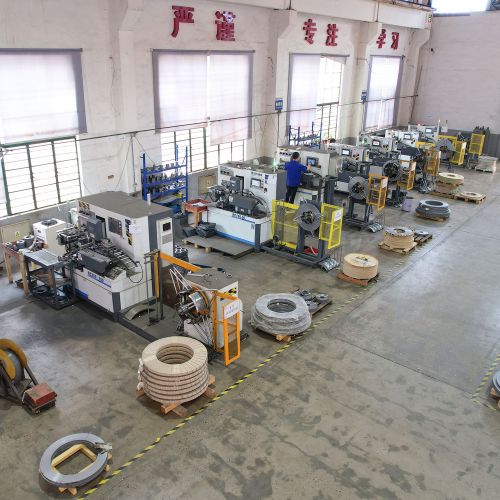
Problem Definition: Why a Correct Datasheet Still Produces a Wrong Core
A datasheet is written by a supplier to describe a product family, but it is read by a buyer to answer a project question. Those two purposes do not align automatically, and the gap is where selection errors appear.
- Loss quoted without its conditions. A figure such as ≤1.0 W/kg is meaningless until you know the flux density (1.5 T), the frequency (50 Hz), and the measurement basis (loss per kilogram of core mass). Remove any of those and the number stops being comparable to another supplier's number.
- Temperature quoted without a definition. An “operating range” of −40 °C to 120 °C may describe ambient conditions, component surface conditions, or a short-term excursion limit. These are different design inputs with different consequences.
- Power quoted as a family range. A span of 100–5000 VA describes the series. It does not tell you what a specific model delivers, and a family range cannot be substituted for the model-level line.
- Model designation read as a specification. The digits inside a designation are a size index within a series. They are not automatically a rated-power readout.
- Bases and units that differ between suppliers. Loss per kilogram versus loss per piece, different reference flux densities, different reference frequencies, and in some markets different unit systems make side-by-side comparison unreliable without normalization.
The practical consequence is that two buyers can read the same document and reach different conclusions, both defensible in isolation. The fix is procedural: read the three critical lines in a fixed order, force each number to declare its conditions, and only then compare candidates.
Industry Background: Standardized Materials, Non-Standardized Datasheets
Core materials are well standardized. Core datasheets are not. Grain-oriented silicon steel (CRGO) accounted for 79.6% of the transformer core market in 2024, according to Mordor Intelligence, which means most datasheets you compare will describe the same base material family in different formats. Publishers differ on overall market scale — Custom Market Insights valued the global transformer core market at USD 9.66 billion in 2024 — but the structural point is stable: a core is an engineered part sold against a technical document, and the document carries much of the selection risk.
Geometry changes the performance envelope before material does. Toroidal cores are reported to reach 90%–98% efficiency, while traditional EI laminated cores typically operate below 90% (Custom Market Insights). That difference is not a reason to pick one geometry on its own; it is a reason to read the geometry and material line of a datasheet before you read the loss line.
Commercially, cores also sit inside a regulated product category. Wound cores of iron or steel for incorporation into transformers are classified under HS code 8504.90.96.42 in the US tariff schedule. The datasheet therefore plays two roles at once: it is the technical contract with the design team and the supporting document for the trade and customs file.
Standards references add a third layer. A datasheet may name IEC 60076 or ANSI C57 as applicable standards. A named standard is a statement of design intent and market applicability; it is not a certificate, and it does not identify which clauses were tested. Reading the standards line correctly means treating it as the start of a verification question rather than the end of one.
The Three Lines That Decide Fit: Loss, Temperature, Power
Nearly every mismatched core selection traces back to one of three lines. Read them in a fixed order: loss first, temperature second, power third. Loss tells you what the core costs electrically. Temperature tells you what it costs thermally and where its limit sits. Power tells you which model in the series you are actually permitted to consider.
1. Core loss — read the condition before the number
NCW CORE specifications state core loss as ≤1.0 W/kg at 1.5 T / 50 Hz. That single line carries three separate pieces of information:
- ≤1.0 W/kg — specific loss, normalized per kilogram of core mass, not per unit and not per model.
- 1.5 T — the peak flux density at which the figure applies.
- 50 Hz — the excitation frequency.
If your design runs at a different flux density or a different frequency, the 1.0 W/kg figure becomes a comparator rather than a prediction. Loss rises with both flux density and frequency, so the same core will not return the same W/kg in an application that pushes either parameter higher. The correct use of the datasheet number is therefore twofold: hold it constant to rank candidate cores at identical conditions, then request data or a sample test at your own operating conditions before you commit.
The same discipline applies across product families. YadooTEK lists EI lamination cores on a CRGO silicon steel base with a lamination thickness of 0.2–0.3 mm and core loss of no more than 1.2 W/kg at 1.5 T. The NCW figure of ≤1.0 W/kg and the EI figure of ≤1.2 W/kg are only meaningfully comparable because the reference flux density matches; before drawing any conclusion, confirm that frequency, specimen, and test method match as well.
2. Temperature — find out what the number defines
NCW CORE models are specified for an operating range of −40 °C to 120 °C. That line answers one question and raises two more.
It answers: within what envelope is the core expected to function? It does not establish whether 120 °C is an ambient limit, a component surface limit, or a short-term excursion limit, and it does not state the temperature rise the core produces at rated power. Those are three different numbers with three different design consequences:
- Ambient range describes the environment the core must survive.
- Temperature rise describes what the core adds on top of that environment.
- Limit temperature describes the point beyond which performance or material integrity is no longer guaranteed.
A core can be fully within a −40 °C to 120 °C operating range and still perform poorly in a sealed enclosure, because the enclosure raises ambient above the design assumption. The correct reading procedure is to note the range, then ask the supplier which definition it uses and what rise is expected at your load and duty cycle.
3. Power rating — a family range is not a model rating
The NCW CORE series is listed with a rated power span of 100–5000 VA and eleven model designations: NCW100, NCW150, NCW200, NCW300, NCW350, NCW500, NCW750, NCW1000, NCW1500, NCW2000, and NCW2500.
Two reading rules follow. First, the span 100–5000 VA describes the family, not any individual model; the model you intend to quote must be confirmed against its own rated power line. Second, the numeric portion of the designation is a size index inside the series, not a VA figure you can assume. The series runs from NCW100 to NCW2500 while the stated rated power range extends to 5000 VA — enough to show that the digits are not a straight VA readout. Treat the designation as a lookup key and the rated power line as the specification.
Reading rule: read loss for the condition, temperature for the definition, and power for the model. A number that has lost its condition has lost its meaning.
Step-by-Step: A Seven-Step Reading Order for Any Core Datasheet
The sequence below turns a datasheet from a list of values into a decision record. It works on NCW CORE sheets and on any supplier document structured the same way.
- Start with material and geometry. Note the base material and the core construction before touching any electrical figure. YadooTEK's portfolio spans wound and laminated constructions, including toroidal cores, C cores, EI/ED/SD/CD cores, stepped laminated cores, thin strip cores, permalloy cores, distribution-gap cores, and silicon-steel rectangular cores. Geometry sets the expected performance envelope, so it belongs at the top of your notes.
- Read the loss line and highlight its conditions. Copy the number and its reference flux density and frequency together, as one unit. For NCW CORE that unit is “≤1.0 W/kg at 1.5 T / 50 Hz”. Never carry the number forward without the condition.
- Normalize before you compare. Align units (W/kg versus loss per piece), reference conditions, and specimen definition across every candidate. If a supplier states loss at a different flux density, ask for the figure at 1.5 T before building a comparison table.
- Interrogate the temperature line. Confirm which definition is in use — ambient range, surface range, or excursion limit — and request the expected rise at your load. For NCW CORE the stated operating range is −40 °C to 120 °C; the definition behind it is a question for the supplier, not an assumption for the buyer.
- Map rated power to the model, not the family. Locate the rated power of the specific model under consideration inside the 100–5000 VA series span, then check the margin against your actual load rather than the nominal figure.
- Cross-reference the designation against the requirement. Build a three-column record: requirement, what the datasheet states for the candidate model, and the gap. Using NCW100 through NCW2500 as the lookup range, this step usually separates two or three candidate models from the rest and exposes the one parameter that still needs confirmation.
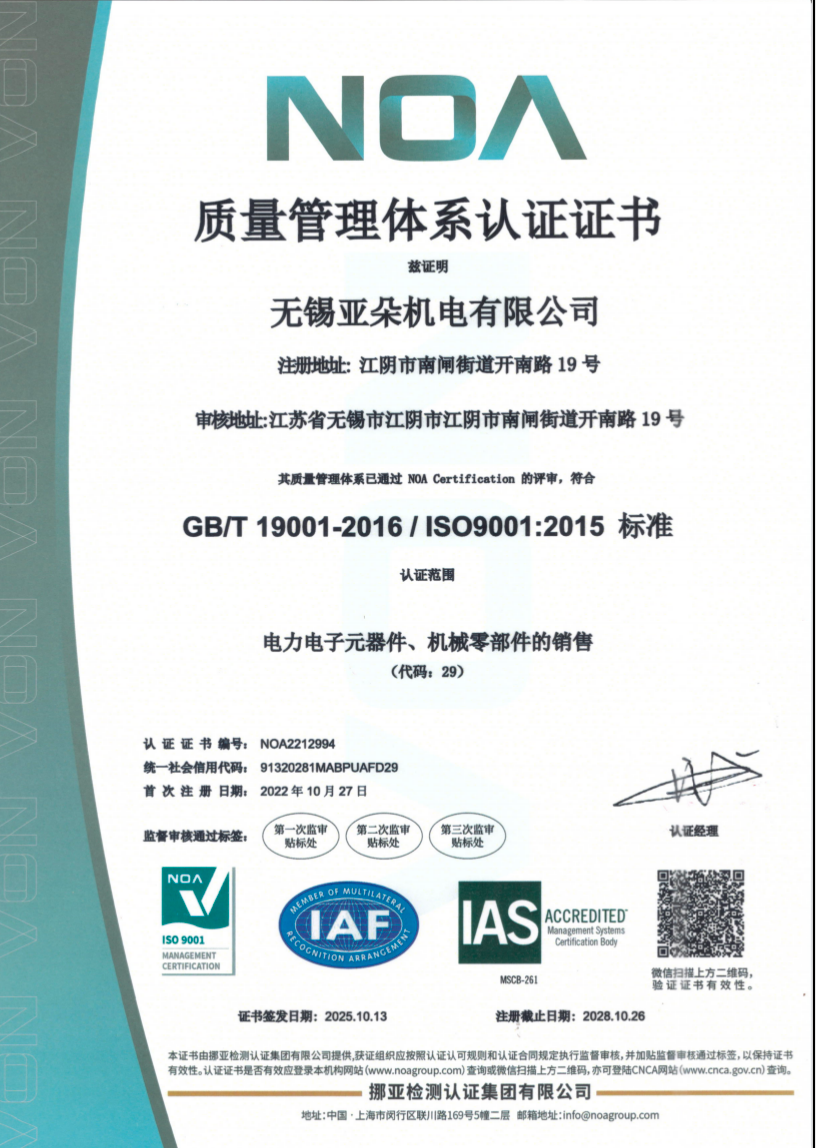
- Verify the evidence behind the sheet. A datasheet describes intent; the quality system describes control. YadooTEK holds ISO 9001:2015 certification, certificate no. 91320281MABPUAFD29, issued by Noah Testing & Certification Group Co., Ltd. on 13 October 2025 and valid through 26 October 2028, with a scope covering the sale of power electronic components and mechanical parts. The company states 100% testing before delivery and operates core magnetic testing instruments together with transformer capacity and loss testing instruments — the equipment category that produces the loss figures on the sheet.
Frequent omission: buyers often verify the loss number and stop there. The temperature definition and the model-level power rating are the two lines most likely to be missing from a short quotation, and both affect whether the selected core can be used at all.
Use Cases: Where the Reading Method Changes the Decision
Power conversion and transformer builds
In a power application the binding constraint is usually the combination of loss budget and thermal headroom, not the headline loss figure alone. With NCW CORE models rated across 100–5000 VA, the reading task is to confirm that the chosen model's rated power covers the load and that its ≤1.0 W/kg figure at 1.5 T / 50 Hz was measured at conditions close enough to the design point to be predictive. If the design runs at a higher flux density, the loss line becomes a starting reference and the sample test becomes the decision.
Energy monitoring and metering
Metering and sensor designs — current and voltage transformers, industrial sensors, power metering equipment, and smart grid terminals — depend on stability rather than a single low number. In a 5000-unit core project of this type, reported results include high-precision metering, low-loss operation, strong anti-interference, and compliance with IEC international standards. Read the datasheet accordingly: the operating range (−40 °C to 120 °C) and the loss condition matter together, because a core that drifts across the operating envelope creates a metering problem that no bench measurement at room temperature will reveal.
Medical and precision equipment
Medical power supplies and precision instrumentation are sensitive to predictable thermal behaviour. The reading method does not change: confirm the loss condition, confirm what the temperature range defines, and confirm the model-level power rating. What changes is tolerance for ambiguity — a design with limited thermal margin cannot absorb an undefined temperature line. Where a standard geometry does not fit, YadooTEK's portfolio includes permalloy cores, thin strip cores, CD cores, and distribution-gap cores, and the company offers OEM/ODM customization of size, specification, and material.
Datasheet Field Reference: What to Verify Before You Approve a Core
The table below converts each datasheet field into a verification question. It is deliberately short: these are the fields that change a selection decision, not every line a supplier may print.
| Datasheet field | What the entry establishes | Confirm before selection |
|---|---|---|
| Material and geometry | The construction family and expected envelope | That the construction matches the application, not just the price band |
| Core loss (W/kg) | Specific loss at a stated reference condition | That the loss basis is per kilogram and the specimen is comparable |
| Reference flux density and frequency | The conditions under which loss was stated | Whether your design operates at or near those conditions |
| Operating temperature range | The envelope the core is expected to function within | Whether the figure describes ambient, surface, or excursion limits |
| Rated power (VA) | The power class of a specific model | That the value applies to the model quoted, not the family span |
| Model designation | A lookup key inside the series | That the digits are not assumed to equal the VA rating |
| Standards referenced | Design intent and market applicability | Which clauses were tested, and against which evidence |
| Quality and test evidence | How the stated values are controlled in production | Certificate scope, validity, and the test regime (100% test versus sampling) |
Applied to two specification lines from the same supplier, the same method exposes which values are stated and which must be requested:
| Specification line | NCW CORE | EI lamination core (YadooTEK) |
|---|---|---|
| Core loss | ≤1.0 W/kg | ≤1.2 W/kg |
| Reference flux density | 1.5 T | 1.5 T |
| Reference frequency | 50 Hz | Not stated in the specification line — request it |
| Base material | Not stated in the specification line — request it | CRGO silicon steel |
| Thickness | Not stated in the specification line — request it | 0.2–0.3 mm |
| Stated rated power | 100–5000 VA across the model range | Not stated in the specification line — request it |
| Stated operating temperature range | −40 °C to 120 °C | Not stated in the specification line — request it |
“Not stated” is not a defect in the product; it is a gap in the document you were given. The correct response is a written request, not an assumption — because an assumption is what turns a comparable datasheet into a mismatched core.
Frequently Asked Questions
What compliance evidence should accompany a transformer core datasheet?
A datasheet is not compliance evidence by itself. Two documents are worth checking. First, the quality management certificate: YadooTEK holds ISO 9001:2015 certification, certificate no. 91320281MABPUAFD29, issued by Noah Testing & Certification Group Co., Ltd. on 13 October 2025 and valid through 26 October 2028, with a scope covering the sale of power electronic components and mechanical parts. Second, any product-scope certificate — and the scope line matters. A CE certificate is held under number B-S00051E0199R1, issued by BEIDE, valid from 17 September 2025 to 16 September 2028, against EN 61869-1:2009 and EN 61869-2:2012; its scope covers current transformers rather than transformer cores. Reading the scope correctly is part of compliance reading. Standards named on a datasheet, such as IEC 60076 or ANSI C57, indicate design intent and must be matched to clause-level test evidence.
How do I cross-reference NCW100–NCW2500 model designations against a project requirement?
Build a three-column record: requirement (rated power, loss budget at your flux density and frequency, operating temperature), what the datasheet states for the specific model, and the gap. Use the designation only as a lookup key inside the NCW CORE series, which runs from NCW100 to NCW2500 with a stated rated power span of 100–5000 VA, then confirm the rated power line for the individual model. Do not infer the VA value from the digits. Where no standard model closes the gap, YadooTEK offers OEM/ODM customization of size, specification, and material, supported by a 25-engineer R&D team, so the requirement does not have to be reshaped around the catalogue.
How should I compare quotes when two core datasheets look identical?
Compare at identical conditions or not at all. Align the loss basis (W/kg versus loss per piece), the reference flux density (1.5 T), the reference frequency (50 Hz for the NCW CORE figure), and the specimen definition. Then align the commercial and quality terms that change the landed comparison: test regime, order quantity, and schedule. YadooTEK states 100% testing before delivery, a minimum order quantity of 1 unit, and a lead time of 45–60 days, with monthly capacity of 10,000 units — those three facts move a quote comparison far more than a marginal difference in a headline loss number measured under different conditions.
How do I validate a sample core against its datasheet?
Test at your conditions, not the datasheet's. Confirm that the sample matches the model quoted rather than a family representative, measure loss at your operating flux density and frequency, and check dimensional and mass consistency against the drawing. Then run a thermal check inside the intended enclosure, because the −40 °C to 120 °C operating range describes an envelope and not a rise. A sample that meets ≤1.0 W/kg at 1.5 T / 50 Hz has demonstrated the datasheet condition; it has not yet demonstrated your application condition.
What lead time and MOQ should I plan for NCW CORE orders?
The stated terms are a minimum order quantity of 1 unit and a lead time of 45–60 days, against monthly capacity of 10,000 units, with OEM/ODM customization available for size, specification, and material. For evaluation, the practical path is to start with a sample, verify it against your own operating conditions, and then move to the production model. YadooTEK has supplied cores to clients across Europe, North America, Asia, and the Middle East, with projects implemented in more than 30 countries including Germany, the United States, Australia, and Brazil. To request a sample or a quotation, contact Lucien at lucien@yadootek.com or via WhatsApp on +86 17768348101.
Conclusion: Read the Condition, Then Decide
Reading a transformer core datasheet well is a discipline of attaching conditions. The loss figure only means something with its flux density and frequency. The temperature range only means something once you know whether it describes ambient, surface, or excursion limits. The power rating only means something when it belongs to the specific model rather than the family span.
Applied to the NCW CORE series, the three checks are concrete: ≤1.0 W/kg at 1.5 T / 50 Hz, an operating range of −40 °C to 120 °C, and a rated power span of 100–5000 VA across models NCW100 through NCW2500. Cross-referencing those values against a stated project requirement — with the designation treated as a lookup key and the model-level rating as the specification — is what prevents a mismatched core from reaching a power, metering, or medical build.
Wuxi Yado Electromechanical Co., Ltd. (YadooTEK) was established in 2022 and is based in Jiangyin City, Wuxi, Jiangsu Province, China, supplying wound and laminated transformer cores to export markets. Full specifications and the product catalogue are available at www.yadootek.com.
Validate the datasheet against your own operating conditions
Request an NCW CORE sample or a quotation, and test the loss, temperature, and power lines at your flux density and frequency before you commit to a production model. The technical catalogue is available for download.
Download the Catalogue (PDF)Request a Sample or Quote
Contact: Lucien · lucien@yadootek.com · Tel +86 13912495853 · WhatsApp +86 17768348101 · No. 19, Kaishan Road, Nanjiao Sub-district, Jiangyin City, Wuxi City, Jiangsu Province, China.
Have Questions or Need More Details?
Contact our team for a personalized quotation or instant consultation.
Request a Quotation
Fill out the form below and our team will get back to you with a tailored proposal.
WhatsApp Direct Chat
Prefer to chat in real-time? Message us on WhatsApp for instant assistance & quick answers.
- Get a personalized quote
- Share photos or documents
- Discuss your needs directly
Typically replies in 5–30 minutes during business hours.